Explore Louisiana: A Holiday Road Trip Beyond New Orleans
Bonfires on the levee, a riverfront glowing with holiday lights, and Cajun dance halls packed on a Saturday morning. This is the Louisiana most travelers drive right past.

Most Louisiana trips begin and end in New Orleans, and it’s easy to understand why. But the city is a single stop in a state that also holds prairie dance halls, swamp roads, and small towns where Christmas has been celebrated the same way since the 1920s.
December is a particularly good time to see that side of the state. Natchitoches strings its riverbank with lights. Along the Mississippi, whole communities stack logs on the levee and set them alight for Papa Noël. And because December here tends to be mild, a day on foot in a historic district or in a boat on the swamp is entirely comfortable.
For travelers in Texas, Arkansas, Mississippi, Alabama, Tennessee, and the Florida Panhandle, most of this route sits within a half day’s drive. Any one region fills a long weekend nicely; string several together and you have a proper holiday loop.
North Louisiana: Natchitoches and Shreveport-Bossier
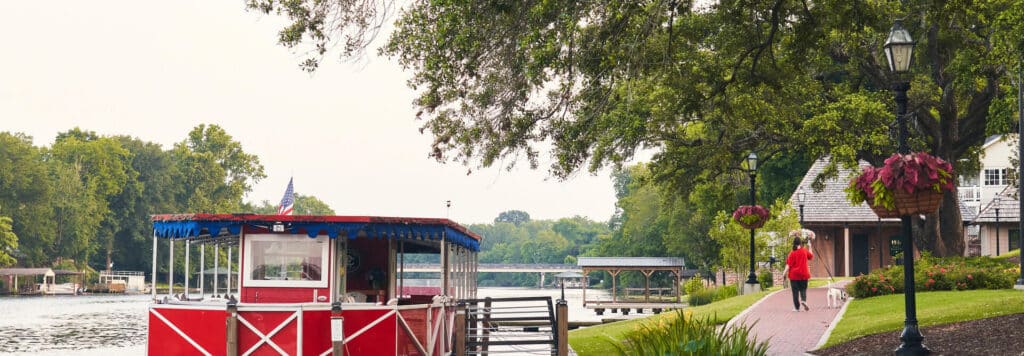
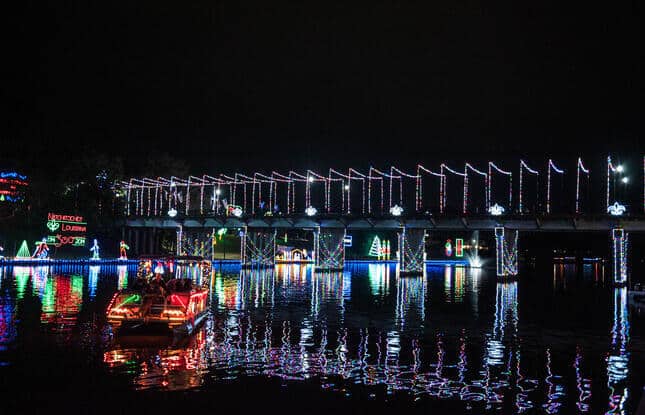
Start with the name. Natchitoches is said NACK-uh-tish, and the town has had since 1714 to get used to visitors mangling it; it’s the oldest permanent settlement in the entire Louisiana Purchase. This year it throws its 100th Christmas Festival of Lights, a tradition dating to 1927. Between November 21, 2026, and January 6, 2027, more than 300,000 lights and over 100 lighted set pieces line the banks of Cane River Lake, coming on each night at dusk.
Festival Day lands on Saturday, December 5, with a parade through downtown, market stalls crowding the streets, and fireworks bouncing off the water after dark. Miss it, and nearly every other Saturday of the season still puts live music on the riverbank stage and sends up another round of fireworks. Between events, order a Natchitoches meat pie, the crimped, fried turnover of seasoned beef and pork that the town is known for.
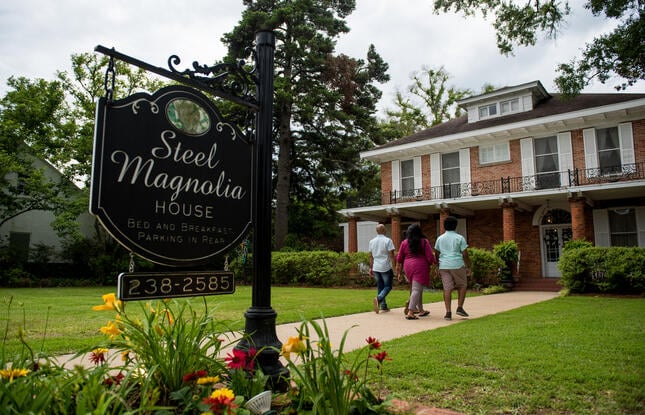
Come morning, follow the river south into the Cane River National Heritage Area, where pecan orchards and old Creole homesteads line the road. Cane River Creole National Historical Park and Melrose Plantation hold more than two centuries of history between them: Creole families, the enslaved people whose labor built these plantations, and artists like folk painter Clementine Hunter. Road trip tip: rooms go fast on festival weekends, so book early or fall back on Alexandria, about an hour south.
Drivers from Dallas, Little Rock, and East Texas will likely hit Shreveport-Bossier first, about 75 minutes north of Natchitoches on I-49. In December the American Rose Center opens its gardens at night for Christmas in Roseland: millions of lights along a walking path, a small holiday train, s’mores, and Santa holding court.
Central Louisiana: Kisatchie National Forest
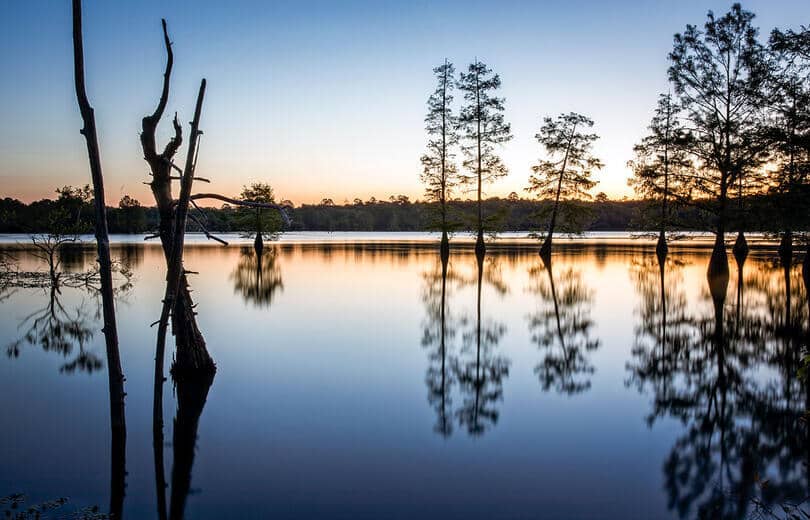
Louisiana’s reputation for being flat as a skillet falls apart in Kisatchie National Forest. The state’s only national forest sprawls across more than 600,000 acres between Natchitoches and Alexandria, and parts of it hardly look like Louisiana at all: longleaf pine, sandstone bluffs, and creeks running clear over sand.
The Longleaf Trail Scenic Byway covers it in about 17 miles, though it’ll take longer than you’d think thanks to the overlooks and short trailheads along the way. If you only make one stop, make it Longleaf Vista, where in December you’ll often have the view to yourself.
Alexandria works well as a base. Right in the middle of the state on I-49, it’s an easy overnight between Natchitoches and Cajun Country, and the obvious backup when the festival books every room farther north.
The Cajun Prairie: Eunice, Mamou, Ville Platte, and Opelousas
Drive southwest from Alexandria and the pines thin out until there’s little ahead but rice fields and crawfish ponds, with a small town every so often where Cajun French still comes up at the cash register. This is the Cajun Prairie. Come on a Saturday if you possibly can.
Begin the morning in Mamou, where Fred’s Lounge has hosted a live Cajun dance and radio broadcast on Saturday mornings for decades. It’s not unusual to see couples two-stepping by mid-morning. Fifteen minutes down the road in Eunice, the Savoy Music Center hosts a weekly jam where accordion and fiddle players pull chairs into a circle and trade songs. That evening, find a seat at the Liberty Theater for Rendez-vous des Cajuns, a live Cajun and zydeco show broadcast on regional radio, with plenty of French mixed into the banter.
Make sure to bring an appetite as Ville Platte calls itself the smoked meat capital of the world, and after one stop at a meat market selling smoked sausage, tasso, and boudin by the pound, it’s hard to argue. Opelousas, with a strong claim to being the birthplace of zydeco, is the place for Creole dance halls and plate lunch counters.
Acadiana: Lafayette, Breaux Bridge, and the Bayou Teche
Lafayette makes the most sense as a base for Acadiana. Vermilionville is a good first stop: a living history village on the banks of Bayou Vermilion where musicians, craftspeople, and restored homes tell the Acadian, Creole, and Native American story. In December, Acadian Village lights up its 19th-century homes for Noël Acadien au Village, an evening a lot of Lafayette families treat as an annual outing.
On the way in or out, detour through Scott, which calls itself the boudin capital of the world, and sample a few links at the counter. And when a cold front blows through, expect gumbo on every chalkboard menu in town, the roux cooked nearly to the color of chocolate.
Breaux Bridge, ten minutes east, is famous for crawfish, though plenty of visitors remember it for the Saturday zydeco breakfast, where the dancing starts before the coffee’s finished. Just outside town, the road around Lake Martin passes through cypress hung so thick with Spanish moss that it filters the light. Beyond that is the Atchafalaya Basin, the largest river swamp in the country. Take a boat tour out of Henderson, or let the I-10 Atchafalaya Basin Bridge carry you about 18 miles across open water and flooded forest.
For the last leg, trace the Bayou Teche Scenic Byway south through St. Martinville, home of the Evangeline Oak and the Acadian Memorial, and New Iberia’s historic Main Street. End on Avery Island, where Tabasco has been made since 1868.
Southwest Louisiana: Lake Charles and the Creole Nature Trail
Houston to Lake Charles is about two hours on I-10, short enough for a Friday-night departure. From there, the Creole Nature Trail, one of only a few dozen All-American Roads in the country, loops roughly 180 miles south through marsh and wildlife refuges to the Gulf.
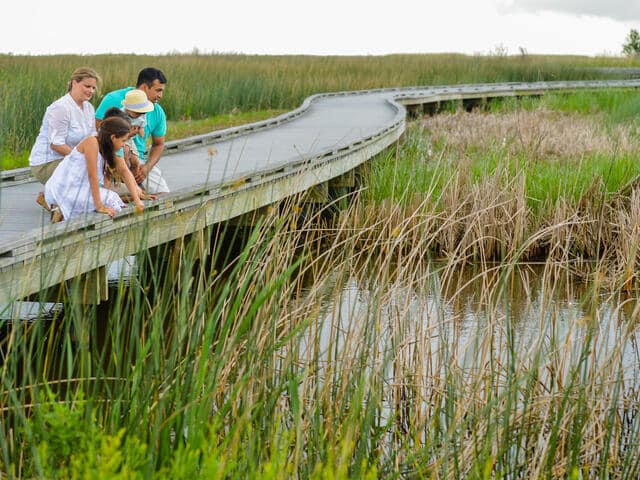
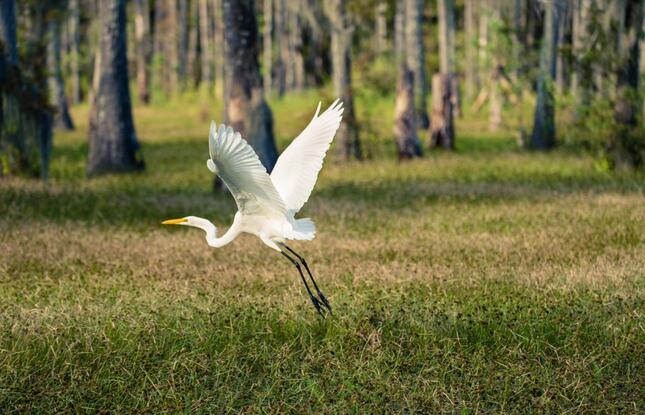
Go in winter. That’s when millions of ducks, geese, and wading birds come south and settle into the coastal marsh, and the boardwalk at Sabine National Wildlife Refuge puts you close enough to hear them. Holly Beach, which locals affectionately call the Cajun Riviera, is farther down the road, and in December you may share its shoreline with no one but the gulls.
Along the Mississippi: River Road and St. Francisville
Between Baton Rouge and the outskirts of New Orleans, the Mississippi is the setting for Louisiana’s most dramatic holiday tradition. Through December, families in the St. James Parish communities of Gramercy, Lutcher, and Paulina build wooden pyramids along the levee. On Christmas Eve, they’re lit to guide Papa Noël down the river, and the sight of dozens burning along the bank at once is hard to forget. If you can’t be there on December 24, the Festival of the Bonfires in Lutcher offers music, food, and an early lighting on a December weekend.
On the River Road, Whitney Plantation in Wallace builds its tour around the lives of the enslaved people who lived and worked there, told partly through first-person accounts from formerly enslaved Louisianans. Laura: A Creole Plantation in Vacherie, a short drive away, follows one Creole family across several generations. Neither is meant to be rushed.
Up the river past Baton Rouge, St. Francisville sits on a bluff above the Mississippi, all live oaks and antebellum homes. In early December, Christmas in the Country brings out lights, carolers, and a good share of the parish for holiday shopping downtown. Save a morning for Audubon State Historic Site, where John James Audubon painted a number of his bird studies.
How Close Is Louisiana? Plan Your Route
For most of the South, Louisiana is a one-tank drive. The table below shows approximate drive times from each market to the nearest region on this route.
Driven end to end, the route runs about 400 miles. Five to seven days gives each region its due, and any single stop above makes a satisfying long weekend.
Ready to go? Start planning your Louisiana road trip on Roadtrippers and add every stop from this guide to your route. For more ideas, events, and travel inspiration, visit Explore Louisiana.
Meet the Author

Get more vacation inspiration straight to your inbox.
By entering your email, you agree to receive marketing emails from Roadtrippers. You can unsubscribe at any time. See our Privacy Policy.



 Download from Play Store
 Download from Apple App Store
