Not unlike countless other roadtrippers, I’m inexplicably drawn to the rural stretches of the United States highway system. There is a tone you can feel in a vehicle when a desert horizon flattens a city skyline. There’s a tangible reassurance when the road begins to work with the contours of the landscape instead of against them. These places are still very wild. They represent a piece of us that is at risk of vanishing. This past summer I wanted to make something that paid homage to a rapidly disappearing chapter in American history: the age of roadside attractions.
Who among us doesn’t feel a sense of uneasy wonder when we pass a forlorn business in a lesser-traveled corner of the country. A gas station separated by 100 miles of high alpine sage fields on both sides – a diner buried in soot from a long abandoned industrial operation nearby. Locations that we now refer to as ‘ghost towns’ were all, at one point, simply known as ‘towns.’ These places – artifacts of a temporal civilization – ask us to reckon with our own role in history. Oftentimes when I observe these things I’m reminded of the words of the late great Rod Sterling.
“You’re traveling through another dimension — a dimension not only of sight and sound but of mind.”
The aforementioned chapter in American history (the one I said was at risk of disappearing) was broadly set into motion in the 80’s as the robust interstate network began to replace the humble highway system. Most people are familiar with the historic drop in travelers along historic Route 66 as I-55, I-44, I-40, I-15, and I-10 gradually devoured its utility. Route 66 was not, however, the only stretch of road to be bypassed throughout the 80’s and 90’s. Countless ‘towns’ gradually devolved into ‘ghost towns.’ Populations in previously bustling areas dwindled – and in many cases, evacuated entirely. Even so, a few brave stragglers were sometimes known to linger behind.
The opposite of pioneers – when the surrounding masses left in search of bigger and more profitable places, these few bravely stayed to weather the hardships of a dying town. Call them stubborn, call them resolute. Regardless of their motive – these bold individuals refused to leave on behalf of the rapidly changing landscape. Not unlike the rest of us however, they still required the bare minimum in order to adapt and survive. They needed money. Since traffic was increasingly rare, every passing car became an essential opportunity to lure in a sale. The question was simple: “how do we get as many cars to pull over as possible?”
Further reading...

Insert: the great American Roadside Attraction.
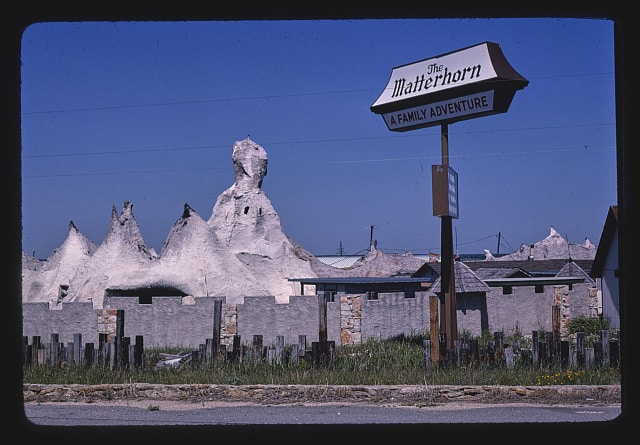
Here in time we find normal Americans relying on strange solutions to strange problems. Auto mechanics built dinosaur sculptures, cafes constructed enormous donuts. In one particularly mysterious case, a massive plaster replica of the Swiss alps loomed over a restaurant in Prairie Dell, Texas.
Admittedly, this is a vast generalization. There’s no singular reason why the US has so many scrappy dinosaur sculptures or ‘worlds largest fill in the blank’s. There’s a lot that happens in this ‘chapter’ but it is still, very much, a chapter. It’s far more rare for these obscure shrines to pop up now than it was in the 80’s. Marketing has shifted away from big tangible stunts and more towards small digital tactics. In the year of our lord 2026, It’s uncommon for a regular person to face the exact set of circumstances that created the American network of roadside artwork that exists today. What’s not uncommon in modern times however, is the well documented disappearance of roadside attractions.
When I learned of Roadside America by John Margolies I immediately knew I wanted to explore the topic further. This collection of over 11,000 color photographs beautifully documents some of the country’s strangest and most beautiful examples of roadside art. Some still exist, but many are lost to time. Instead of flipping through the pages of an already completed work, I realised I wanted to contribute my own verse to a masterpiece that belongs to us all. It is here, dear reader, that I leave you to watch the film I made this summer. It attempts to fill in the current blank that we find ourselves in – the time after these works of human resilience have served their purpose. What is to become of them now? As a slight spoiler I’ll say this: I think roadside attractions are worth preserving because they represent us, Americans, at our absolute best. We are resolute, we are creative. We are scrappy and sincere. We do things that are wonderfully and subjectively beautiful.
America’s Weirdest, Wildest, and Raddest Roadside Attractions for Your Next Road Trip
I titled this film “Venite Ad Me Omnes” because it is a latin phrase most commonly used on the bases of sculptures of Jesus. Its English translation: “Come to Me, Everyone,” meant so much to me in the exploration and creation of this film. These objects served as a sort of salvation to the people that built them. That salvation manifested in the arrival of people drawn in by sheer wonder and curiosity.
Earlier I mentioned a quote by Rod Sterling. That quote was only half complete. The remaining phrase goes like this:
“A journey into a wondrous land whose boundaries are that of imagination. That’s a signpost up ahead: your next stop: the Twilight Zone.”
I hope you all enjoy my own little journey into the Twilight Zone. VENITE AD ME OMNES.
Meet the Author


 Download from Play Store
 Download from Apple App Store