250 Years in 2,500 Miles: The Ultimate America250 Road Trip From Boston to Selma
From Boston's Freedom Trail to Selma's Edmund Pettus Bridge, this 2,500-mile route turns America's 250th birthday into a driveable timeline of revolution, founding, victory, and reckoning.

In 2026, the United States turns 250. And while there will be parades, fireworks, and a year of official America250 programming from coast to coast, the most powerful way to mark the Semiquincentennial isn’t to watch it on a screen. It’s to drive it.
This 2,500-mile road trip is built like a timeline you can steer. It starts where the Revolution ignited, runs through the rooms where the country was argued into existence, passes the battlefield where independence was won, and ends in the Alabama towns where Americans fought to make the promises of 1776 real for everyone. Two and a half centuries, one tank at a time.
Here’s how to plan it.
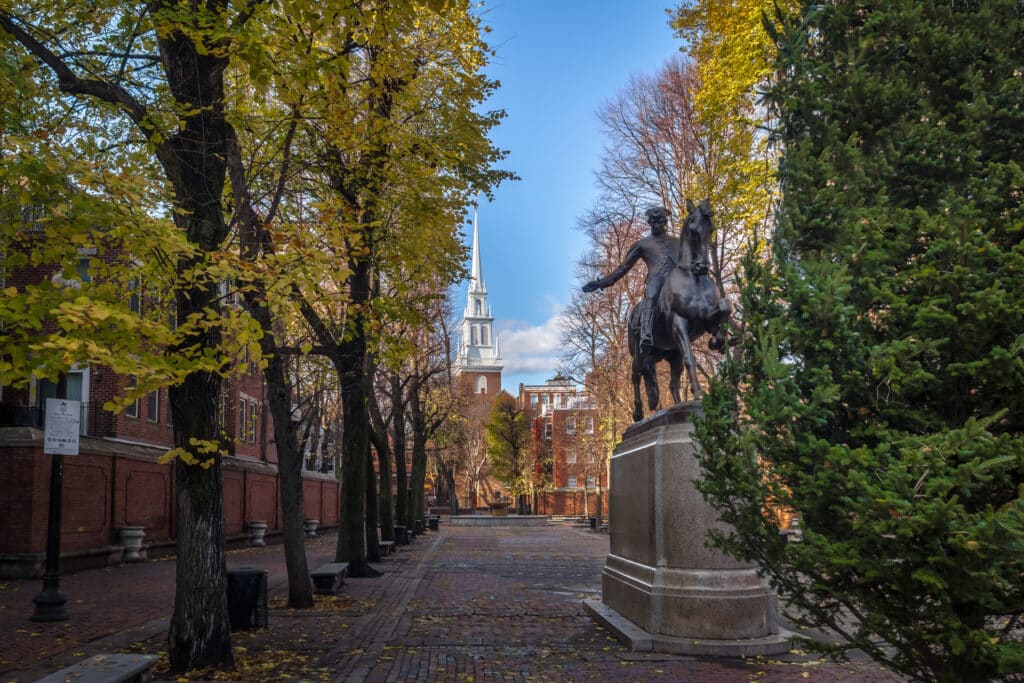
Stop 1: Boston, Massachusetts (The Spark)
Every American story starts somewhere, and this one starts on the Freedom Trail. The 2.5-mile red-brick path links 16 sites tied to the run-up to revolution, including the Old North Church (where the lanterns hung in 1775), the Paul Revere House, and the Granary Burying Ground, where Sam Adams, John Hancock, and the victims of the Boston Massacre are buried.
Add a half-day in Lexington and Concord, about 20 miles northwest, to walk Battle Road Trail at Minute Man National Historical Park. This is where the “shot heard round the world” was fired on April 19, 1775. Stand on the North Bridge at sunrise and the rest of the trip clicks into focus.
RV Trader Campground Picks: Normandy Farms Campground in Foxborough offers a full-service, big-rig-friendly stay, while Spacious Skies Minute Man in Littleton is a quieter, wooded base closer to Revolutionary sites.
Drive to the next stop: Boston to Philadelphia, roughly 310 miles via I-95.
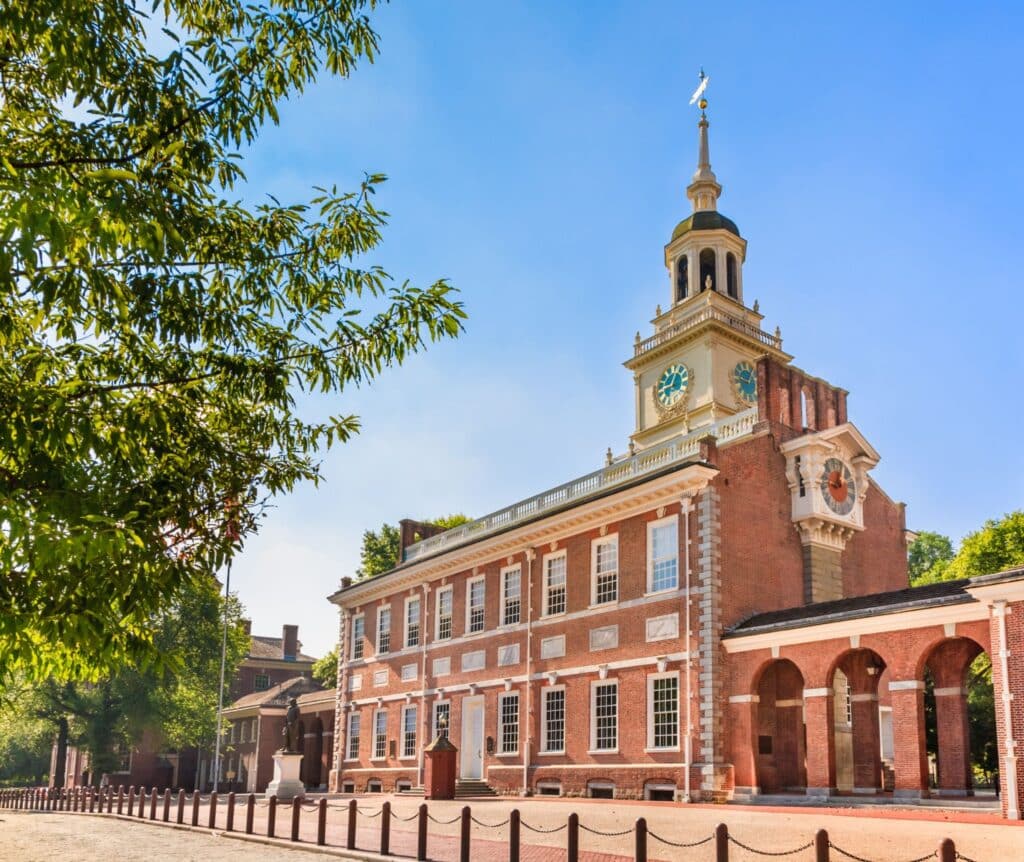
Stop 2: Philadelphia, Pennsylvania (The Founding)
If Boston was the spark, Philadelphia was the engine room. Independence National Historical Park is the densest cluster of founding history in the country: Independence Hall (where the Declaration was signed and the Constitution drafted), the Liberty Bell, Carpenters’ Hall, and Congress Hall.
Plan to spend a full day. Reserve free timed tickets to Independence Hall in advance through the National Park Service. Add the Museum of the American Revolution for context and the National Constitution Center to see how the document has been argued over for 250 years.
Philadelphia is one of America250’s leading host cities, so expect special exhibits, programming, and the long-awaited reopening of the First Bank of the United States in 2026.
RV Trader Campground Picks: Philadelphia South / Clarksboro KOA and Timberlane Campground, both in New Jersey, keep you outside the city with an easy commute into historic Philly.
Drive to next stop: Philadelphia to Washington, DC, about 140 miles via I-95.
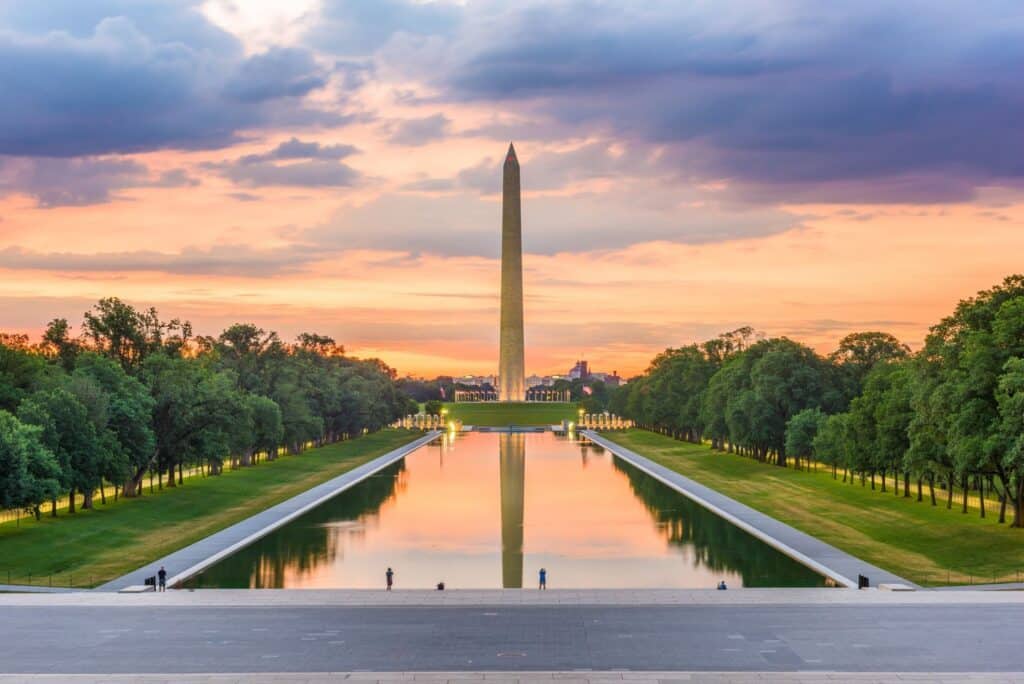
Stop 3: Washington, DC (The Republic)
Washington is where the experiment scaled up. Build the day around the National Mall: the Washington Monument, the Lincoln Memorial, the Jefferson Memorial, and the World War II, Korean, and Vietnam memorials, all walkable from one another.
For the founding-era through line, the National Archives is non-negotiable. The original Declaration of Independence, Constitution, and Bill of Rights live there, and the Archives is mounting a special 250th anniversary exhibition for 2026. Pair it with the Smithsonian’s “Our Shared Future: 250” programming, which spans 21 museums and the National Zoo throughout the year.
If you have an extra morning, the National Museum of African American History and Culture is the best possible bridge to the next leg of this trip. It traces the American story from slavery through the Civil Rights movement and forward, and it reframes everything you see south of here.
RV Trader Campground Picks: Cherry Hill Park in College Park pairs full amenities with direct transit into DC, while Greenbelt Park offers a more natural National Park Service setting nearby.
Drive to next stop: Washington, DC to Yorktown, Virginia, about 175 miles via I-95 and I-64.
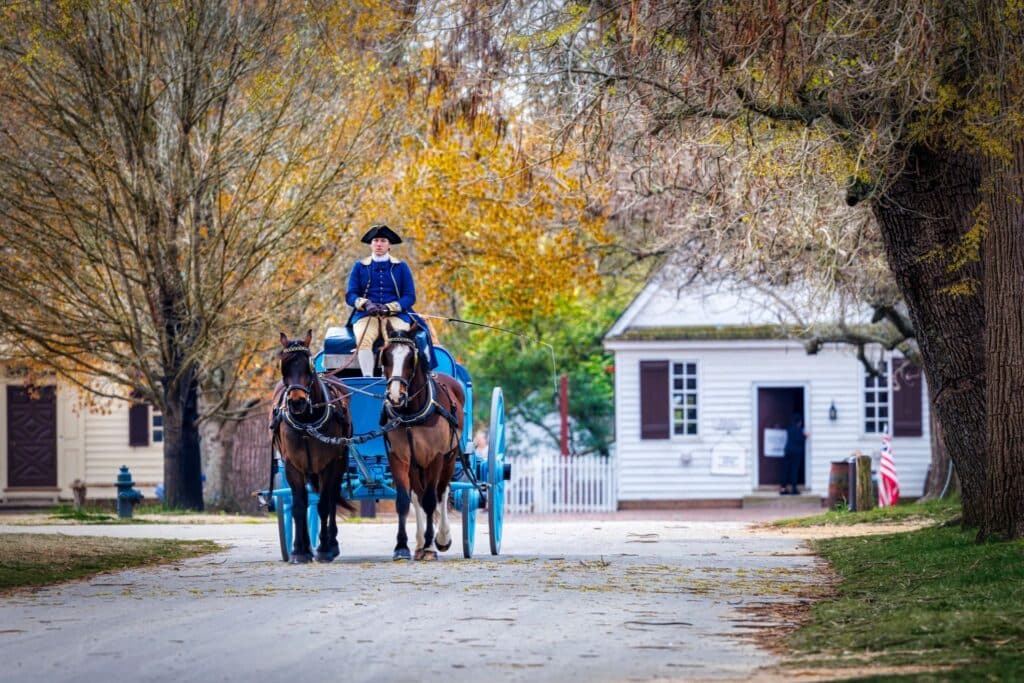
Stop 4: Colonial Virginia (The Victory)
The Historic Triangle of Jamestown, Williamsburg, and Yorktown packs 200 years of early American history into a 23-mile loop. Jamestown was the first permanent English settlement (1607). Colonial Williamsburg is a living-history town where you can talk to costumed interpreters playing Patrick Henry, Martha Washington, and enslaved Virginians whose labor built the colony. Yorktown Battlefield is where Cornwallis surrendered to Washington in 1781, effectively ending the Revolutionary War.
Drive the Colonial Parkway between the three. It’s one of the prettiest 23 miles in the country, with no billboards, no commercial traffic, and the York and James rivers on either side.
RV Trader Campground Picks: American Heritage RV Park and Anvil Campground in Williamsburg put you centrally between Jamestown, Williamsburg, and Yorktown.
Drive to next stop: Yorktown to Greensboro, North Carolina, about 240 miles. From there you’re crossing into the Civil Rights South.
Stop 5: The Civil Rights Trail (The Reckoning)
This is where “past and present” stops being a slogan. The U.S. Civil Rights Trail links more than 130 sites across 15 states tied to the movement of the 1950s and 1960s. For a 2,500-mile budget, focus the route on five anchor stops:
Greensboro, NC: The International Civil Rights Center & Museum, built around the Woolworth lunch counter where four students launched the 1960 sit-in movement.
RV Trader Campground Picks: Oak Hollow Campground in High Point offers a scenic lakeside stay, while Greensboro KOA Journey is the more convenient, full-amenity option.
Atlanta, GA: The Martin Luther King Jr. National Historical Park, including his birth home, Ebenezer Baptist Church, and his tomb. Pair with the Center for Civil and Human Rights.
RV Trader Campground Picks: Stone Mountain Park Campground delivers one of the largest, most amenity-rich stays in the region, while Sweetwater Creek State Park offers a quieter base closer to the city.
Birmingham, AL: The 16th Street Baptist Church, Kelly Ingram Park, and the Birmingham Civil Rights Institute. This is where the violence of 1963 forced the country to confront itself.
RV Trader Campground Picks: Oak Mountain State Park Campground provides space and scenery just outside Birmingham, while Birmingham South RV Park in Pelham is the more convenient full-hookup stop.
Montgomery, AL: The Legacy Museum and the National Memorial for Peace and Justice from the Equal Justice Initiative are among the most important museums built in the last 25 years. Add the Rosa Parks Museum and the Dexter Avenue King Memorial Baptist Church.
RV Trader Campground Picks: Capital City RV Park keeps you close to downtown sites, while Gunter Hill Campground offers a quieter, waterfront setting outside the city.
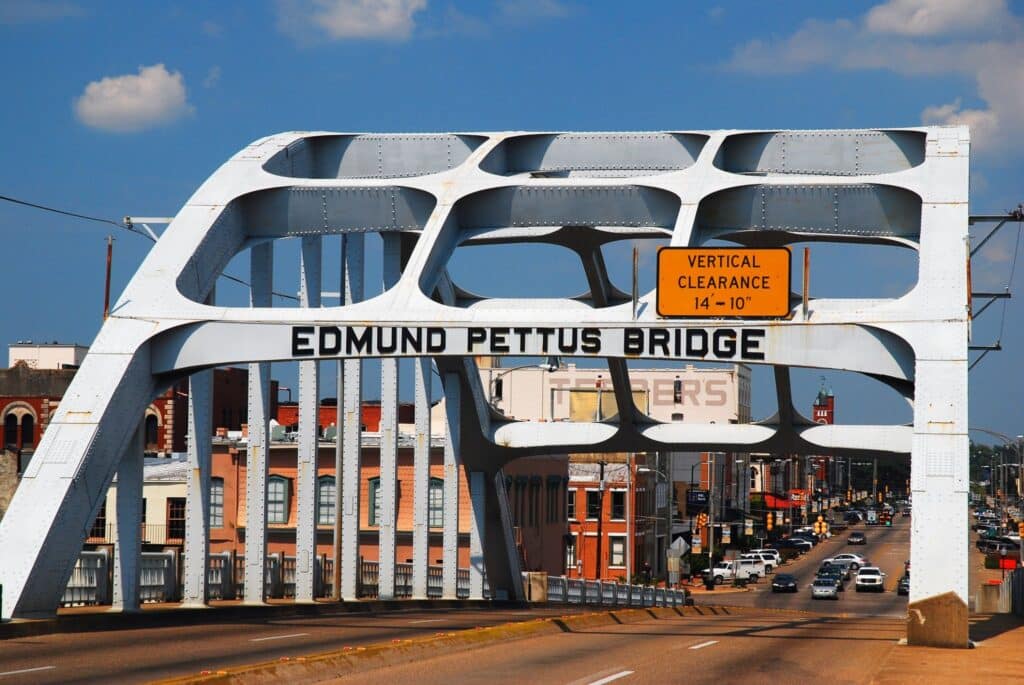
Selma, AL: Walk across the Edmund Pettus Bridge. On March 7, 1965, state troopers attacked peaceful marchers here on what became known as Bloody Sunday. The Voting Rights Act passed five months later.
RV Trader Campground Picks: Prairie Creek Campground and Paul M. Grist State Park Campground both offer peaceful, scenic stays within driving distance of Selma.
Roughly 2,500 miles after leaving Boston, you end on a bridge in Alabama where Americans risked their lives to extend the promise of 1776. That’s the trip.
Plan it Right
Give yourself 14 to 21 days if you can swing it. Reserve timed tickets for Independence Hall, the National Archives, and major Smithsonian exhibits well ahead of summer 2026, when crowds will be at their peak. If you’re traveling by RV, the route has excellent campground coverage from Boston through Virginia and great options across the Civil Rights corridor, so book early for July and you’ll be set.
Map the full route in Roadtrippers, drop in your stops, fuel breaks, and overnight stays, and you’ve got a once-in-a-generation trip ready to roll.
Because here’s the thing: 250 years only happens once. The country has spent two and a half centuries arguing, building, marching, and reinventing itself, and every mile of this route is proof that the story is still being written. You get to add a chapter.
Meet the Author

Get more vacation inspiration straight to your inbox.
By entering your email, you agree to receive marketing emails from Roadtrippers. You can unsubscribe at any time. See our Privacy Policy.


 Download from Play Store
 Download from Apple App Store