The RV Monitoring Hack Most RVers Don’t Know They Need
Smart sensors and real-time alerts let you keep an eye on your RV, your pets, and your belongings from anywhere.

Your rig is parked at camp. You’re 40 minutes away at a trailhead with no visibility to your RV. Here’s how to stop wondering if everything’s okay back there.
Every RVer knows the feeling. You’ve finally found the good site, the one with the creek and the afternoon shade, and you head into town for groceries, or up the trail for a few hours, or out to dinner because you’ve earned it.
And then, somewhere between the trailhead and the parking lot, your brain starts running its checklist.
Did I leave the fan on for the dog? It was 68 degrees when we left, but that sun’s been hitting the south side all afternoon. Did the pedestal trip again like it did in Moab? Is that slow drip under the bathroom sink actually fixed, or did I just tighten it enough to feel better about it?
You can’t answer any of those questions from where you’re standing. So you either cut the day short and drive back to check, or you spend the next three hours only half-enjoying yourself. Neither one is why you bought an RV.
Which is exactly the problem Winegard built RV Halo to close.
What RV Halo Actually Is
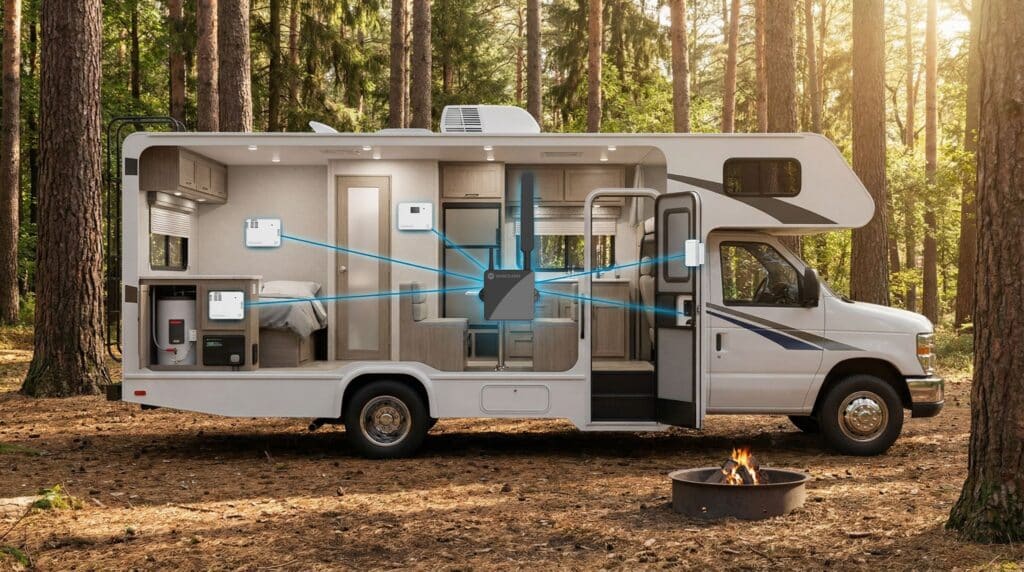
RV Halo is a smart monitoring system for your RV, built around three pieces: a hub that lives in your rig, a set of small sensors you place where they matter, and an app on your phone that ties it all together.
The app is the part you’ll actually interact with. It syncs your smart devices in one place, shows you the status of your RV at a glance, and pushes alerts to your phone when something changes. No hunting through four different manufacturer apps. No wondering which sensor is talking to what.
The important distinction, and the reason this is different from the tank monitor you already have, is that RV Halo is built to tell you things while you’re not there. It’s less a dashboard and more a set of tripwires you get to define yourself. (Remote monitoring and control features run through an RV Halo Pro membership; local monitoring works on its own.)
Here’s what that looks like in practice.
1. Security and Geofencing: Knowing Your Rig Hasn’t Moved
RV theft is the kind of thing you don’t think about until you’re the one standing in an empty campsite. And it’s not always dramatic. Trailers get taken from storage lots, from driveways, from long-term sites in the shoulder season when nobody’s around to notice for weeks.
RV Halo’s hub includes built-in GPS and lets you draw a custom geofence around your rig. If your RV crosses that boundary, your phone knows. Not eventually. Right then.
The geofence is more flexible than it sounds. Set it tight around a storage lot for the off-season. Set it wide enough to cover a campground loop so you’re not getting pinged every time you reposition. Either way, you get location data and a real-time alert instead of a phone call from a neighbor three days later.
On top of location, contact sensors on doors and windows tell you whether anything’s been opened. A door that opens while you’re eight miles up a canyon is information worth having. So is a door you thought you locked showing up as closed and secure. That’s the alert that lets you keep hiking.
2. Pet Climate Safety: The One That Matters Most
If you travel with a dog, this is the use case that justifies the whole system.
RV interiors heat up fast, faster than most people expect and much faster than the outside temperature suggests. A rig sitting in direct sun with the AC running on shore power is comfortable right up until the pedestal trips, the generator runs dry, or the AC unit faults out. Then you’ve got a sealed metal box in the sun with your dog inside and no way to know.
A temperature and humidity sensor inside the RV monitors conditions continuously and alerts you when they cross a threshold you set. You decide the number. If it’s 78 degrees inside and climbing, you find out at 78, not when you walk in at 6 p.m.
That’s the difference between an inconvenience and an emergency. It gives you the two things you need most in that scenario: time, and the ability to act. Call the campground host. Text the neighbor. Turn around now instead of in an hour.
Worth noting: the same sensors work in your RV fridge. If you’ve ever come back from a three-day trip to a cooler full of spoiled groceries, you know why that’s useful.
3. Power Loss Alerts: Catching the Failure That Causes Every Other Failure
Almost every bad RV surprise traces back to power. The pedestal trips. A breaker pops. Something gets unplugged. And because power loss is silent, you don’t discover it until you discover its consequences: the warm fridge, the dead batteries, the hot interior, the frozen pipes.
RV Halo’s hub detects power loss and alerts you, and it carries an internal backup battery so it can still reach you after the power’s gone. That last part is the whole trick. A monitoring system that loses power along with everything else isn’t monitoring anything.
This is the alert that pays for itself in the shoulder seasons and in storage. If you leave your rig plugged in over the winter to keep the batteries topped off and a tender maintained, a tripped breaker in January is an expensive discovery to make in April.
4. Water Leak Detection: The Slow Disaster
Water damage is the most expensive thing that can happen to an RV short of a collision, and it almost never announces itself. A fitting weeps behind a wall. A water heater connection loosens over a few hundred miles of washboard road. A drain backs up under the shower pan.
By the time you see a stain or smell something musty, you’re usually looking at delamination, soft floor, or rotted framing. Those are repairs that run into the thousands and take your rig off the road during the season you wanted to use it.
Water sensors placed in the usual suspects (under the sink, behind the water heater, near the pump, in the wet bay) catch it at the drip stage. That’s the difference between tightening a fitting and rebuilding a subfloor.
It’s the least exciting item on this list and probably the one with the highest expected value.

How It Comes Together
Individually, each of these is a nice-to-have. Stacked, they add up to something more useful: a running answer to the question you’ve been asking yourself in the background this whole time.
The hub anchors the system with GPS, geofencing, power monitoring, and its backup battery. The sensors (temperature and humidity, contact, motion, water) go where your specific rig has specific risks. Winegard sells them individually or as a sensor pack, and the ecosystem is built to bring partner devices into the same app rather than fragmenting them across five logins.
Setup is a weekend-afternoon project, not a wiring job. Place sensors, pair them, set your thresholds and your geofence, and you’re done.
Who This Is Actually For
If you’re a full-timer, a boondocker, someone who travels with pets, someone who stores their rig somewhere they can’t see it, or anyone who takes long day trips away from camp, this closes a real gap. It converts a category of low-grade, all-day anxiety into a phone that stays quiet until it shouldn’t.
Focus on the Adventure
You didn’t buy an RV to think about it. You bought it to get somewhere: the trailhead, the coast, the town with the good diner, the site with the creek and the afternoon shade. The whole point of monitoring is that you stop having to monitor. Set your thresholds, draw your geofence, and let the system carry the checklist your brain has been running for you.
Focus on the adventure. Let RV Halo track the rest.
Meet the Author

Get more vacation inspiration straight to your inbox.
By entering your email, you agree to receive marketing emails from Roadtrippers. You can unsubscribe at any time. See our Privacy Policy.




 Download from Play Store
 Download from Apple App Store