Best RV Warranties: How to Confidently Protect Your RV Travel Budget
Learn how RV extended warranties work, what they cover, what RV repairs can cost, and how to choose the best RV warranty for the way you travel.

You planned the route months ago. Campground reservations, a couple of hard-to-book state parks, that one detour everybody told you was worth it. Then somewhere outside of nowhere, the transmission starts slipping.
Here’s the version of that story worth telling. You call it in, a mobile tech meets you at the campground, the covered repair goes through, you pay your deductible, and by the weekend you’re back on the route you planned. The trip has a chapter in it now instead of an ending.
That’s what an RV extended warranty buys you. Not a guarantee that nothing breaks, but the confidence to keep going when something does.
How an RV extended warranty works in your favor
An RV extended warranty, more formally an extended service contract, covers the cost of qualifying mechanical and electrical breakdowns after your manufacturer’s warranty runs out. A covered component fails, you pay your deductible, and the policy takes care of the rest of the qualifying repair.
Practically, that means your budget stops being tied to your rig’s worst day. The refrigerator that quits cooling in July, the slide-out motor that gives up in a national forest, the engine that needs more than a roadside fix: each of those becomes a known, small number instead of an open question.
It works alongside your RV insurance rather than replacing it. Insurance handles collision, theft, weather, and physical damage. Your warranty handles breakdowns. Together they cover the two ways an RV can cost you money unexpectedly, which is why most experienced RVers carry both.
What RV repairs can cost
RVs are houses bolted to vehicles. You get all the freedom that comes with that, and you also get every system a car has plus every system a home has, built with specialized parts and serviced by specialized labor.
Knowing the numbers is what makes the coverage decision easy.
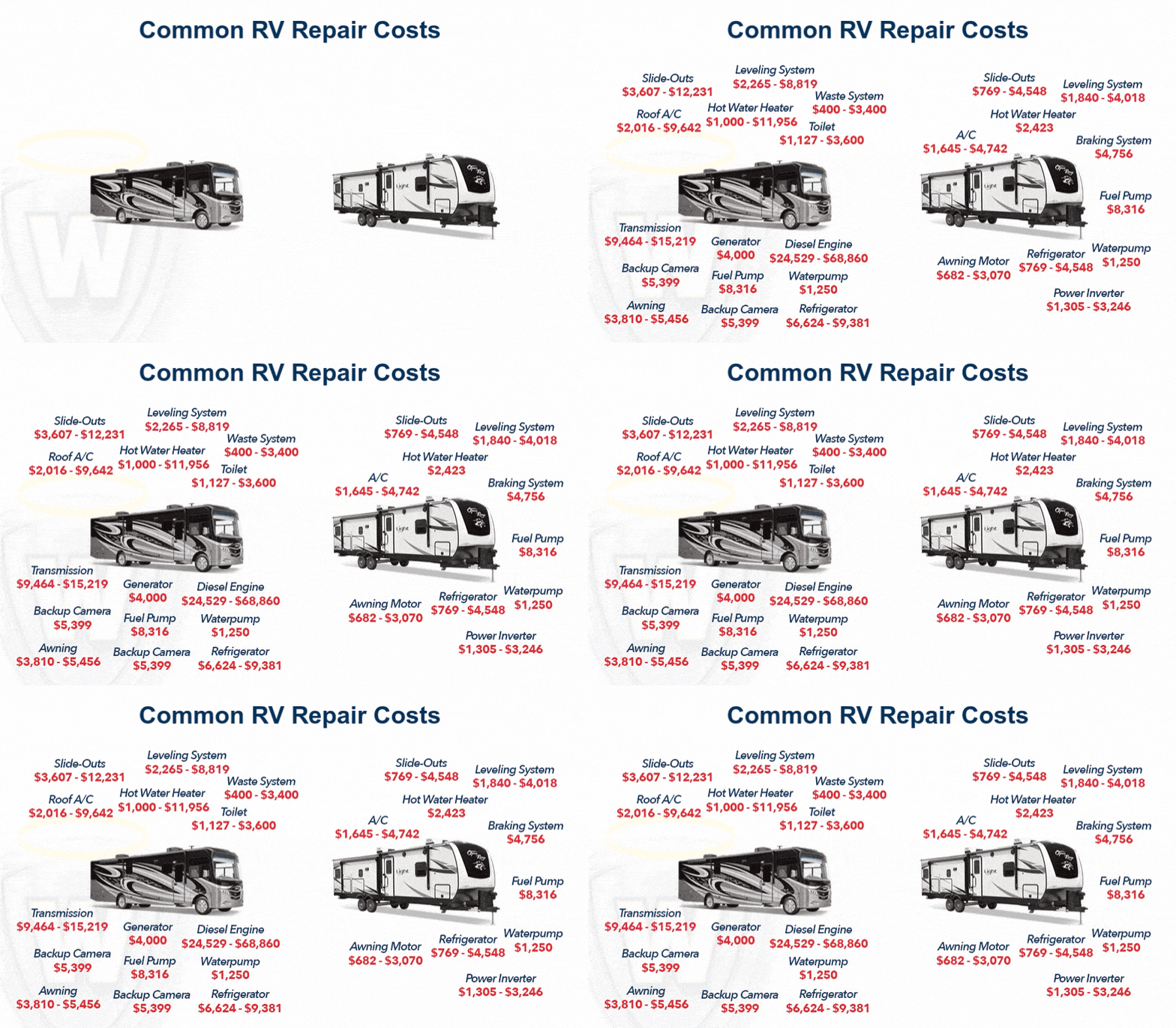
Engine repairs on a motorhome can run anywhere from $24,000 to $70,000 depending on severity and whether it’s gas or diesel. Transmission work lands between $9,000 and $15,000. A roof A/C unit runs $2,000 to $10,000, a refrigerator $6,500 to $10,000, a generator up to $4,000.*
Now picture those same repairs with coverage in place. Each one resolves at your deductible, and the difference stays in your travel fund, going toward the sites, the fuel, and the miles you actually bought the rig for.
That’s the whole value proposition in one line: a single covered claim can pay for the policy several times over.
*Estimated RV repair costs based on Wholesale Warranties claims experience and industry repair estimates. Actual repair costs vary by RV, component, labor rates, parts, and severity of failure.
The four levels of RV warranty coverage
Different RVers need different things, and the best policy is the one built around your rig and how you use it. Wholesale Warranties offers four levels so you can match coverage to your travel life.
Exclusionary RV Warranty
The most complete protection available. Rather than listing what’s covered, the contract lists the small set of items that aren’t, which means anything that isn’t on that short list is covered. Expect protection across major mechanical and electrical components in both the chassis and the coach, and on many plans that extends to premium features like solar systems and washer/dryer units. This is the plan for RVers who want to stop thinking about it entirely.
Comprehensive RV Warranty (listed component)
Spells out every covered component by name, so you know exactly what you have. The list covers the components that matter most and cost the most: engine, transmission, brakes, refrigerator, air conditioning, wiring, leveling systems, and slide-outs. It’s broad protection at a friendlier price, and it’s a community favorite for good reason.
Coach Only RV Warranty
Protects everything living in the house side of your rig, including slide-outs, leveling jacks, air conditioning, and appliances. It’s a great fit when your powertrain is still covered by the manufacturer, and it opens the door for higher-mileage motorhomes to get meaningful protection where they need it most.
Powertrain Only RV Warranty
Puts your dollars directly against the biggest potential repairs: engine, transmission, and drive axle. If you’re comfortable handling the small stuff yourself and just want the catastrophic scenarios off your plate, this delivers that at the lowest price point of the four.
Worth knowing: Wholesale Warranties covers commonly failed items that competitors often leave off their contracts, including wiring, wiring harnesses, and generators. Those are exactly the components RVers are surprised to find excluded elsewhere.
Which coverage fits your travel style?
The right plan depends less on your rig’s spec sheet than on how you actually use it. A weekend camper 90 minutes from home and a full-timer crossing three time zones a year are protecting different things.
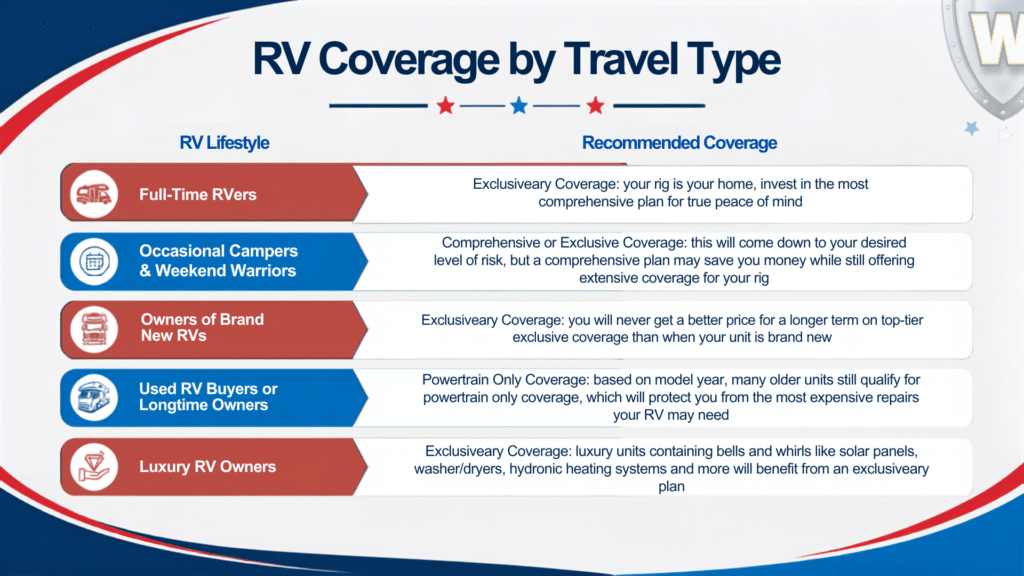
A few things worth applying alongside the graphic:
Locking in early gets you the most. Eligibility is broadest and pricing is best on newer, lower-mileage rigs, so the strongest move is to get a quote while your factory warranty is still running. Coverage can pick up right where the manufacturer leaves off.
More miles means more value. Components wear on a duty cycle, so the RVers logging serious annual mileage are the ones whose policies tend to pay for themselves fastest.
Distance is where coverage shines. A policy is most valuable exactly where you’re least equipped to handle a repair yourself, which is 1,200 miles into a trip you’ve been planning all year.
Full-timers have the most to gain. When the RV is home, keeping it running is everything. Full-time RVers are eligible for every plan Wholesale Warranties offers, and exclusionary coverage is usually the right place to start the conversation.
How a claim gets paid
A good policy is only as good as the day you use it. Here’s how the process runs.
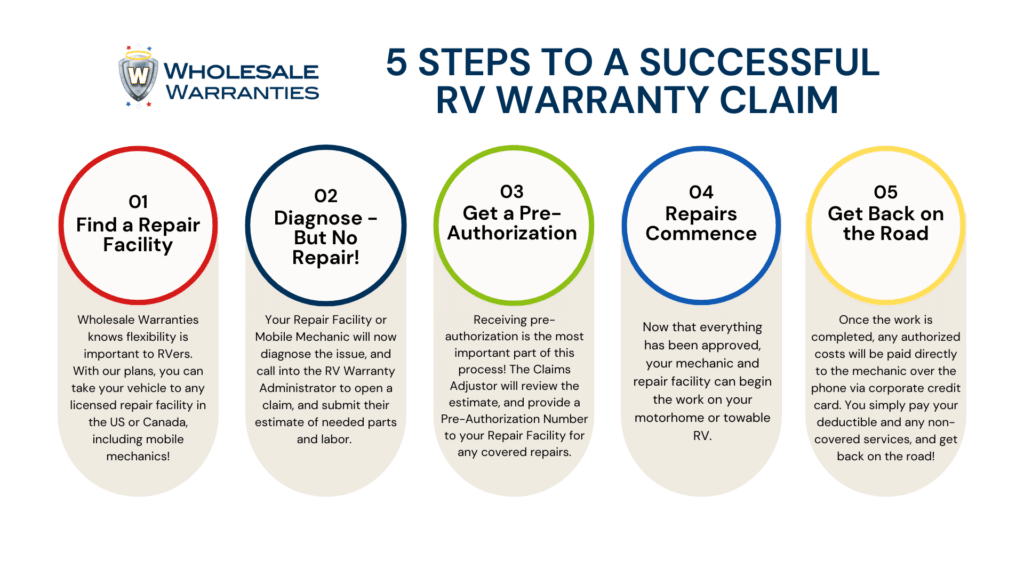
Two things make the RV warranty claims process go smoothly for Wholesale Warranties customers.
Your policy works anywhere in the US or Canada, including mobile mechanics. Every RV warranty Wholesale Warranties offers is valid at any licensed RV repair facility across both countries, and mobile RV technicians are included. That flexibility matters, because breakdowns tend to happen far from your preferred shop. If a mobile tech can handle the repair right there in the campground, your coverage goes with you.
An internal Claims Support Team is in your corner. Wholesale Warranties keeps its own in-house claims staff, whose job is to walk you through the process, answer questions in plain language, and make sure your claim gets handled fairly. When you’re standing in a service bay with a technician on one side and a contract on the other, having an advocate who knows both makes all the difference.
Behind both: nearly two decades in the RV warranty business, and a practice of working only with providers who have a proven history of paying claims.
Finding your policy
Wholesale Warranties works as a broker, which means the goal is finding your best fit rather than selling one product. An RV Warranty Specialist looks at your make, model, mileage, and travel habits, then compares coverage levels, providers, deductibles, and terms to make a recommendation built around you.
Good questions to bring to that call:
- Which components am I most likely to need covered on a rig like mine? Specialists see claims patterns by make and model and can point you toward the right level.
- What deductible structure fits how I travel? The right choice here can meaningfully improve what you get back on a multi-part repair.
- Is the policy transferable if I sell? Many are, and that’s real value at resale.
Get your free quote, plus a year of Roadside Assistance
Quotes are free and come with no obligation. At minimum you’ll walk away knowing exactly what it costs to protect your rig, which is useful information either way.
Roadtrippers members get one (1) free year of RV Roadside Assistance with any new RV warranty purchase. So when help is what you need most, getting it isn’t a separate bill.
Plan the trip. Book the sites. Take the detour. With the right coverage behind you, the only thing deciding where your season ends is you.
The best RV extended warranty is one that fits your specific RV, travel habits, budget, and tolerance for unexpected repair costs. There is no single plan that is best for every RVer. When comparing RV warranties, consider the type and breadth of coverage, exclusions, deductible, repair facility flexibility, claims process, insurance backing, and the reputation of the company and warranty administrator.
An RV extended warranty, also commonly called an RV extended service contract, can help pay for eligible mechanical and electrical breakdowns after the manufacturer’s warranty expires or outside its coverage. Depending on the plan, covered components may include the engine, transmission, generator, air conditioning, electrical systems, refrigerator, water heater, slide-outs, leveling systems, and other major RV components.
It depends on the RV warranty contract. Many RV extended warranties allow owners to use licensed RV repair facilities throughout the United States and Canada, and some plans also permit qualified mobile RV technicians. Other contracts may have different requirements or restrictions, so repair flexibility is an important factor to compare before purchasing coverage.
RV insurance and an RV extended warranty protect against different types of financial risk. RV insurance generally covers events such as collisions, theft, liability, and certain types of physical damage, depending on the policy. An RV extended warranty or service contract is designed to help pay for eligible mechanical and electrical breakdowns of covered components. Many RV owners carry both because the two products serve different purposes rather than replacing one another.
Meet the Author

Get more vacation inspiration straight to your inbox.
By entering your email, you agree to receive marketing emails from Roadtrippers. You can unsubscribe at any time. See our Privacy Policy.




 Download from Play Store
 Download from Apple App Store